Research in Florence March 25th – April 5th 2019
Saturday, 13th April 2019
I met Elizabeth and David from Camberley in Piazza Santo Croce! I caught sight of them as they rounded the corner of the piazza on their way home.
I discovered that I could enter the Duomo free of charge if I took part in the celebration of Mass. One evening I approached one of side entrances and asked the guards where Mass was to be celebrated that evening. Before Mass was about to begin I needed to use the services. When I asked one of the clergy I was ushered the sacristy area where I could choose one the a well designed toilet areas.
The American celebrant asked the congregation if one of them wished to read from the scriptures. Immediately a man from the States rushed forward to inform the priest that his wife was a lecturer. She proved to be a demonstrative lady who also encouraged others to join her in singing the responses to the psalm.
The theme of this lenten Mass was the return of the prodigal son. The majority of the congregation were teenagers. Yet the priest gave a theologically academic sermon instead of engaging the young people. I was so disappointed that I voiced my opinion to one of the attending priests.
Among the places that I visited during the wonderful break in Florence were the following:
1 The marvellous Boboli Gardens behind Pitti Palace. The Medici family established the layout of the gardens, creating the Italian garden style that would become a model for many European courts. The vast green expanse with a regular layout is a real outdoor museum, populated by ancient and Renaissance statues. The Gardens are also adorned with grottos, the most important of which is the famous grotto realised by Bernardo Buontalenti, as well as large fountains, such as the Fountain of Neptune and the Fountain of the Ocean.
When I saw just how high I would have to climb I was a little scared but a very kind guide pointed to less steep paths leading gradually up to wonderful viewing points.
2 DANTE ALIGHIERI was born in Florence in 1265 in sight of where the Museo Casa did Dante is situated. Poet, writer and politician he is considered to be the father of the Italian language. He is the author author of The Divine Comedy, one of the greatest masterpieces of the literally world.
Of course I had visited Dante’s house many times in the past. This time I was delighted to see that it has been turned into a museum. On this occasion when I arrived a guide was speaking about Dante to a group of teenagers accompanied by their teacher. I listened and struggled to follow all that was being explained. I added to my selection books on him with ‘Dante’s Mask’ by Cristina Manetti.
3 The Church of Santi Apostoli e Biagio.
What a beautiful church recommended by Barney and Beth Cantillon, one of our dedicated Italian U3A leaders and his lovely wife. WOW what a hidden treasure especially when I discovered it after passing the touristic, Ponte Vecchio.
This antique via, and the church it is named after, can pretty much sum up the story of Florence in miniature. It encompasses the Romans, Charlemagne also known as Charles the Great, the second “Wall” of the city and it even includes a bit of the crusades and Michelangelo…if you are inclined to believe any of the legends and stories that float around.
The word “borgo” in Italian is a close translation to suburb, a natural outgrowth of the main city. This little alcove is positioned just outside the first walls of the city originally built by the Romans and is called the suburbs of Santi Apostoli. Like so many areas, it flourished right outside the antique Roman walls and in particular this area was close to the Roman Baths and the river Arno, which partially explains why it was never really included in the first circle.
The church houses several pieces of artwork including a della Robbia as well as other beautiful artifacts. However the piece that is most steeped in legend would be the “Pietre del Santo Sepolcro” which was gifted to the church upon the return of Pazzino dei Pazzi to Florence in 1101 from the crusades.
These stones are said to have been used to light the lamps of the tomb when Jesus was buried. It is a relic has traditionally been used to ignite the unique firework display on the “Brindellone” or more officially known as “Lo Scoppio del Carro,” an Easter Tradition that starts in the square in front of the Church.

On Easter Sunday the Scoppio del Carro, or the “Explosion of the Cart”, dating back over 350 years carried on an elaborate wagon decorated in garlands is pulled by a pair of oxen through the streets of Florence to the square between the Baptistry and Cathedral.
This tradition finds its origins in events that are partly historic and partly legendary. A young Florentine named Pazzino, a member of the noble Pazzi family, apparently took part in the First Crusade in the Holy Land in 1099,
where he gave ample proof of his courage (he was the first to scale the walls of Jerusalem and raise the Christian banner). When he came home, he brought back three flints from the Holy Sepulchre that he received for his act of courage. This reliquary, today preserved in the Church of SS. Apostoli lies behind the Florentine celebration for the Resurrection of Christ.
Today, the ceremony still bears a strong resemblance to the way in which it has been celebrated for centuries. Starting around 10am, a priest rubs Pazzino’s three flints together until they spark and light the Easter candle; this, in turn, is used to light some coals which are placed in a container on the Cart and the procession delivers the Holy Fire to the Archbishop of Florence before Santa Maria del Fiore, better known as the Duomo. The cart is accompanied by drummers, flag throwers and figures dressed in historical costume as well as city officials and clerical representatives.
4 Basilica Di Santo Spirito
Again on Barney’s and Beth’s recommendation, I was fortunate enough to visit this Basilica.
An Augustinian Convent which grew into an important Basilica
This church is nestled in a quiet little corner of Florence and it is very possible that you will pass in front of it several times before even really noticing its perfectly proportioned structure.
Not many tourists cross the river to explore the streets, alleys and city squares in the Oltrarno, but if you were to find some extra time then this is the perfect area to breath some authentic Florentine ambiance into your holiday.
When I found maybe Michelangelo’s first masterpiece I wanted to hug Beth!

Michelangelo found refuge in the convent of Santo Spirito in 1492, at the age of seventeen, after the death of his patron Lorenzo il Magnifico. It was within the walls of Santo Spirito that the curious artists had the opportunity to analyse corpses from the convent’s hospital to study the anatomy of the human body.
As a form of thank-you, Michelangelo carved a highly realistic wooden sculpture which hung over the main alter until the French occupation of the late 18th century and the suppression of the convent. At this point cross was recorded as lost.
But actually it was hidden in plain sight!
It had been moved to another chapel and painted to disguise its true origins! Upon the restoration to its original elegance, it went to the museum of Casa Buonarroti, where it remained until 2000 and then re-establish in the sacristy of Santo Spirito.
It is truly beautiful! So finely created.
5 The Basilica della Santissima Annunziata is a Renaissance-style, Roman Catholic minor basilica in Florence, region of Tuscany, Italy. This is considered the mother church of the Servite Order. It is located at the Xnortheastern side of the Piazza Santissima Annunziata near the city centre
There is Mass there every hour.
I found a lovely cafe en-route where I could ask for the amount of coffee that I preferred with hot milk. All explanations achieved in Italian!
6 After Mass I went on to see David in the Galleria dell’Accademia. Wonderful! Initially, when I saw the queue I was about to turn away to return another day but the guards ensured me that that was a very short queue.
You will no doubt know that this is a masterpiece of Renaissance sculpture created in marble between 1501 and 1504 by the Italian artist Michelangelo. David is a 5.17-metre marble statue of the Biblical hero David, a favoured subject in the art of Florence.
I loved the display of such a variety of musical instruments. When I told the lady member of staff that I play the ukulele I expected her to regard this instrument as inferior, however she said that she too played one.

One of the most precious works exhibited at the Accademia is the one-of-a-kind tenor viola made by Antonio Stradivari in 1690. The viola is built in red spruce and maple wood of exceptional quality, decorated with the Medici crest in mother of pearl, ivory and ebony inlays. The tenor viola was part of the top five instruments used by the “Medici quintet”, a unique group of five string elements exclusively built for the Grand Prince Ferdinand and dated 1690. The Viola is an outstanding masterpiece, the only one entirely conserved in its original splendour.
7 Fiesole. I was becoming braver. I had been informed that the number 7 bus would take me all the way. However, I gradually discovered that this service had been discontinued a month earlier. I asked for advice. I was instructed to catch the number 1 bus and change after three stops to where the number seven bus passes. Two Austrian ladies advised me to purchase two tickets at the at a news stands and tabacchi (tobacconists) that will be valid for 90 minutes. One for the return journey too. Total cost will be 3 Euros. The tickets have to be validated in a machine just inside the door of the bus. When the bus stopped a lady who we had befriended from Milan told us to dismount. We said that we had been told to wait until the third stop. She laughed when she informed us that it had not needed to stop at the other two stops!
I loved Fiesole!
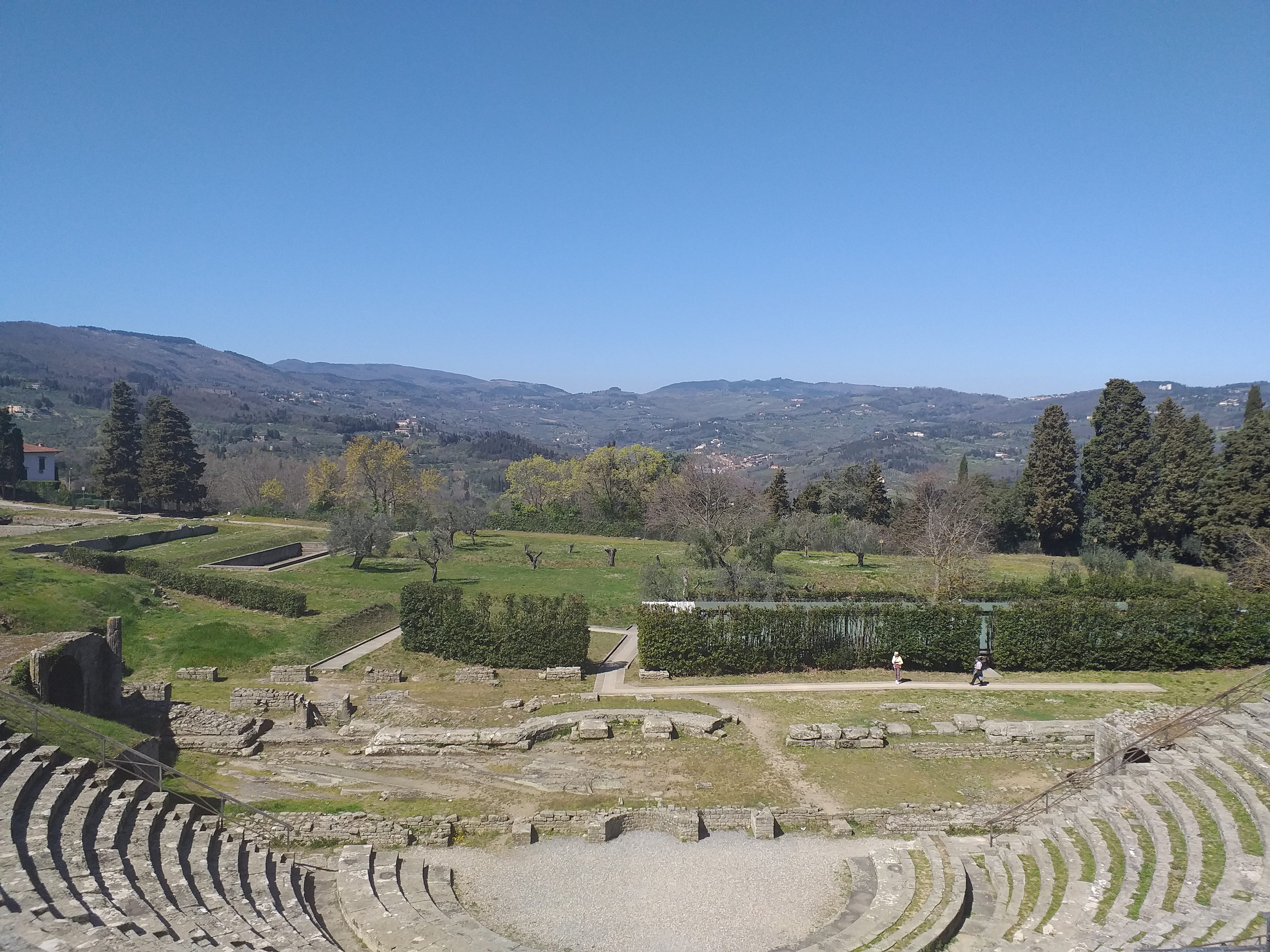
The mystical beauty of Fiesole, less than 10 km outside of Florence, encompasses centuries of history and it is amazing well preserved. Largely unknown by many, this small town hides a wealth of surprises: the massive stones that make up the Etruscan walls, the remains of Roman baths, the green hilltop where Leonardo da Vinci first experimented with the concept of flight, and the Roman amphitheater that still serves as a stage for the Fiesolana summer events. The small city centre is home to a wide range of historical sites, churches and parks where you can spend some time escaping from the hustle and bustle of Florence.
After spending a peaceful morning wandering the museum and historical sites I climbed up to the church and convent of St Francis.
At first, in the 1200s, there was a chapel on this site that was built by a family from Fiesole. Subsequently, a number of Florentine ladies – the “Romite” – moved there and used it as a convent. At the dawn of the 15th century, Bishop Andrea Corsini renovated and extended the earliest convent, called Santa Maria del Fiore, and gave it to the minor friars.
The church and convent complex is in a dominating position, overlooking the Mugnone valley to the west, and occupies the ancient Etruscan rock.
There is a remarkable fifteenth Century cloister with a well, and another smaller cloister from the fourteenth Century. The church itself boasts an “Annunciation” by Raffaellino del Garbo. A number of 15th Century cells may be visited. The convent houses the Franciscan Missionary Museum, which contains an Egyptian and a Chinese collection put together by the missionary fathers to those lands.
When I had consumed my appetising meal later that afternoon the bus was there ready for the return journey. A splendid day spent in sunshine.
8 Piazza San Marco was the busy bus terminus that I had visited to catch the bus to Fiesole. I had hoped to see some of Fra Angelico’s paintings there but I was informed that they were now in the church of San Marco. San Marco is also the name of a religious complex in Florence, Italy. It comprises a church and a convent. The convent, which is now the Museo Nazionale di San Marco, has three claims to fame. During the 15th century it was home to two famous Dominicans, the painter Fra Angelico and the preacher Girolamo Savonarola. Also housed at the convent is a famous collection of manuscripts X in a library built by Michelozzo.
I love this fresco on the wall of the southern corridor. Fra Angelico executed an Annunciation that broadened the pattern of his earlier one in Cortona. The inscription on the pavement reads Salve, Mater pietatis.
This is a huge complex. I thoroughly enjoyed the two hours or more that I spent there.
9 The Ponte Vecchio! Crowded. Throngs of folk feel the need to visit this bridge. Because the characters in my novel ‘A Love As strong’ vowed their love for each other there, it was a must for me.
Although I had not intended to purchase any of the very expensive jewellery on display I was frustrated that very few items in the windows were priced. When one of the assistants invited me inside I remarked on this saying that I did not wish to be embarrassed by my lack of cash. She explained that the reason that the costs are not displayed is because they become vulnerable to robbery once the value of the items on sale are known. Having succeeded in this conversation in Italian I then asked the cost of a beautiful pair of turquoise earrings. We laughed when I revealed that they were more expensive than the cost of my Monastery Stay accommodation! However, I did purchase a much smaller rosette pair for 26 Euros.
I recovered after in one of Florence’s Gelateria!
Ponte Vecchio bridge is a medieval stone closed-spandrel segmental arch bridge over the Arno River. It is noted for still having shops built along it. Butchers initially occupied the shops; the present tenants are jewellers, art dealers and souvenir sellers. Taddeo Gaddi and Neri di Fioravante are the architects. It was built very close to the Roman crossing, the Ponte Vecchio was the only bridge across the Arno in Florence until 1218.
10 Ice cream is a must! Ask for a Gelato in a Gelateria! I sampled a good variety of mouthwateringly delicious flavours. My favourite is definitely stracciatella
Stracciatella is a variety of gelato, consisting of milk-based ice cream filled with fine, irregular shavings of chocolate. It was originally created in Bergamo, northern Italy, at the ‘Ristorante La Marianna’ in 1961, and was inspired by stracciatella soup, made from egg and broth, which is popular around Rome. The word is derived ‘ripped, torn up’, past participle of stracciare.
11 Piazzale Michelangelo Magical Skyline of Florence.
Once more I set off with my now worn map determined to reach Piazzale Michelangelo. I chose to cross Ponte alle Grazie in preference to the ever busy Ponte Vecchio. It was a long climb up to the top but so rewarding once I reached the huge piazza. The views of Florence seen from above is a singular experience. Not just a perfect photo opportunity, but a moment of wonder. You are looking at the city that gave birth to incredible artists, amazing scientist and an enthralling history of discovery and power that has filled novels and movie theatres.
Once the coach of Chinese departed silence I appreciated the silence.

Remembering that on a previous occasion I had enjoyed a cup of coffee in a prestigious restaurant I opted a revisit. I was not disappointed even though initially the attendant looked disgruntled. However, once I established that I am Irish, although I lived in England, she put on Irish music!
12 Il Ragazzi di Sipario, Via dell’Ulivo 6, Firenze
One morning at breakfast a lovely fashionably dressed, polite lady introduced me to this restaurant. in fact she said that I was not to return without having visited this place. This time I made my way from Piazza Croce and once I had found the street leading from there it was a straight road. My map reading had improved.
I had no idea what to expect. I introduced myself to the a young lady who seemed to have learning difficulties. Then I discovered:
I Ragazzi di Sipario is a restaurant operated by kids from ‘Curtain Onlus’, a non-profit social cooperative, offering job opportunities to persons with disabilities or in fragile situations, thus promoting integration and social inclusion.
Christina, Roberto and Mattia, were happy, attentive and friendly. I was offered a 2-course lunch. I enjoyed pasta with sausages and tomato sauce. For the second course, I chose the sliced pork with seasoned white beans and salad. The total cost was € 5! I was glad to find this restaurant and support their programme.
There was an evening performance of a version of Romeo and Juliet advertised to be staged there that evening.
13 Lucca
I wanted to visit another place outside Florence so I chose Lucca
I ventured out to find out how to purchase a rail ticket. When I presented myself in the exceedingly busy Santa Maria Novella station I was guided through the proceedings. I was to take a ticket and join a queue, much as is done in an English Post office. When my number came up I approached the counter and bought return tickets. I had to wait half an hour to board the train. Once again I was reminded to validate my ticket on the platform. It was a comfortable two tiered train. Crowded at first but over the hour and fifteen minutes covering forty-six miles it became almost empty.
Once outside the station a kind taxi-driver gave me a map and pointed to the nearest entry to the walled city of Lucca.
Lucca is a city on the Serchio river in Italy’s Tuscany region. It’s known for the well-preserved Renaissance walls encircling its historic city centre and its cobblestone streets. Broad, tree-lined pathways along the tops of these massive 16th- and 17th-century ramparts are popular for strolling and cycling. Casa di Puccini, where the great opera composer was born, is now a house museum.
The heavens opened and the rain poured down so limiting my exploration. After warming myself with Tuscan soup I hoisted my rain coat hood and wandered around until I found San Michele in Foro is a Roman Catholic basilica church. It was built over the ancient Roman forum. Until 1370 it was the seat of the Consiglio Maggiore, the commune’s most important assembly. It is dedicated to Archangel Michael.
X
I would love to revisit Lucca and walk the walls. I drank coffee and a doughnut before my return journey to Florence. Time flashed by once a man from Seattle and his Spanish lady friend began a long conversation with me.
I became involved in a chaotic exit from Santa Maria Novella station. It is definitely worse than London’s Waterloo station even in the rush hour.
14 Santa Maria Novella is a church in Florence, Italy, situated just across from the main railway station named after it. Chronologically, it is the first great basilica in Florence, and is the city’s principal Dominican church. It is a Gothic Church. Inside, the church is vast and looks even longer than it is thanks to the clever colouring of the central arches. The layout is supposed to be work of Brunelleschi, the same architect of the Duomo‘s cupola.Another huge church run by the Dominican Order with corridors and cemeteries, dormitories and gardens. Vestments and various sacred vessels are displayed and of course there is the book shop.
The purpose of my visit to Florence was research for my third novel and also to help me to improve my Italian.
I wanted to imagine what it would be like for Frankie and Richard (the two main characters in my novel) living there with their son Dante.
I wrote every day. I kept a diary and also took time to plot my next novel. Pen and notebook were always at the ready. I sat and wrote in restaurants, cafes, ice cream parlours, in the convent garden and even in churches. After I have completed this blog I intend to set out the timeline and plot for book three…four if you include my autobiography.
In conclusion to this blog I will recount a few incidents and matters of interest:
A Rivalry among Religious Orders or just differing approaches?
An age-old joke illustrates these differences:
A diocesan priest is hosting a gathering of the area clergy. They gather in the Church to pray Vespers (Evening Prayer), and as they begin, the lights suddenly go out. The Benedictines, as they have the office memorised, continue praying. The Franciscans begin composing a hymn to “Sister Darkness”. The Dominicans compose a treatise on Christ the Light as shown forth in the works of St Thomas Aquinas. The Jesuits begin debating whether this dispenses them from needing to pray the office that evening. The parish priest finds a torch, descends to the basement, and changes the fuse.
I was curious about the dates of each of these religious orders. Which was founded first:
– Benedictines: AD 529 is considered to be the year in which Saint Benedict founded the monastery at Montecassino.
– Franciscans 1209 are a group of related mendicant religious orders founded in by Saint Francis of Assisi.
- The Dominican Order December 22, 1216, Order of Preachers, Augustinian Canons Regular) founded in 1254 by bringing together several eremetical orders in the Tuscany region who were following the
- St Augustine, written by St. Augustine of Hippo in the 5th Century
- Jesuits August 1534. Ignatius de Loyola, a Spanish soldier turned priest.
- Mendicant orders are, primarily, certain Christian religious orders that have adopted a lifestyle of poverty, traveling, and living in urban areas for purposes of preaching, evangelization, and ministry, especially to the poor. At their foundation these orders rejected the previously established monastic model. This foresaw living in one stable, isolated community where members worked at a trade and owned property in common, including land, buildings and other wealth. By contrast, the mendicants avoided owning property, did not work at a trade, and embraced a poor, often itinerant lifestyle. They depended for their survival on the goodwill of the people to whom they preached.
The term “mendicant” is also used with reference to some non-Christian religions to denote holy persons committed to an ascetic lifestyle, which may include members of religious orders and individual holy persons.
B I was nearly robbed. I noticed that young dressed in a black coat was often nearby as I once more traced my way to Piazza Santa Croce. She had black hair and was holding a black umbrella much as a group leader does. Then I felt someone touching my rucksack. I turned round just in time to seeing her fleeing the scene. When I examined by bag I found that it was unzipped. I called out ‘Ladra!’ Robber! The owner of the shop on the other side of the street called me over to enquire if anything had been stolen. Fortunately anything of value was hidden beneath my blouse and under my coat. I related this incident to a few of the police. Since there seems to be a multitude of various types of police I never knew what rank or what kind of duty each were responsible for:
Structure
- Polizia di Stato.
- Guardia di Finanza.
- Arma dei Carabinieri.
- Polizia Penitenziaria.
- Corpo Forestale dello Stato.
- Interforces.
- Provincial Police.
- Municipal Police.
C There were a few characters who introduced themselves each morning in the refectory of our Monastery Stay accommodation:
a) A rather loud, kindly chap who recounted where he was about to visit each day. He encouraged others and on one occasion gave all an account of his medical history. This latter was because he had managed to enjoy a visit to the Uffizi Gallery free of charge. He informed us that any person who suffered a disability was eligible. As his was the potentially serious Crohn’s disease he qualified. However, the following day he climbed the Duomo Bell Tower. Giotto’s bell tower is 82 meters high and to reach the top you’ll need to climb many steps, 414 steps!
But then he gave me a good quality map of Florence and encourage me to visit Lucca. He visits Italy twice annually so he does know his way around.
b) Sonia. A low sized woman who hailed from Billingshurst, West Sussex and claimed to have formerly descended from Irish stock, appeared one morning. Pulling out a chair opposite her she invited me to join her. Then she began her long tale of woe. Two passports together with a sum of money had been stolen from her and she consequently had sought refuge in the convent. She had an impressive list of qualifications and had held senior positions in Italian and Swiss universities. She also owned a dilapidated home in a village in the Cinque Terre region in the rugged Italian Riviera coastline. She continually asked the nuns to phone the English Embassy on her behalf. She told me that she intended to retire to Israel and invited me to join her!
Another similarly dressed and aged women was seated at another table the following day. Instead of selecting a roll or a slice of bread from the food laid out for breakfast, while peering at everyone else she was noisily munching her way through a packet of about twelve sugary trifle biscuits
Near the end of my stay in that accommodation I met these two chatting together as I went out for my evening meal.
c) Supermercato. Some evenings I was too tired to go to a restaurant so I ate a variety of food that I had bought from the local supermarket. Sister Lucy had supplied me with a kettle and more importantly with the sort of adapter needed. I soon became familiar with the procedures of weighing, bagging and Xtagging fruit. But most nights I enjoyed a variety of pastas and a glass of wine.
d) Vocabulary. I carried my Italian/English dictionary every where and also consulted the appropriate mobile phone application. Gradually I learnt and hopefully retained and used a good vocabulary and was consequently able to express myself correctly. If only I had the courage to experiment with an Italian accent. I will do!
e) Beautiful book. I treasure the beautiful book I fell in love with. I had to wait until the last day to purchase it because I was not sure of the balance on my Preloaded cash card and this book cost 25 Euros. It is worth so much more. The preface and introduction is an excellent proclaiming the importance of Dante to Florence and to future Italians.
d) Leather. So many stores displaying a vast variety of leather goods. The markets and stalls throughout the city were overloaded with every imaginable leather products. I was too overwhelmed and unsure about buying of them. Was what was on display genuine leather? How would I know? By touch or smell?
The cost was prohibiting in the more established stores. I even walked around The grand Misuri Store in Piazzo Santa Croce and Gucci and other palatial stores. I also came across a store with the same name as a shop in Limerick called Todds. I had to go in there and tell the staff.
e) Orchestra da Camera Fiorentina Piazza Santo Stefano.
I would have love to attend this concert but the location was at a distance from my accommodation. Alone I feared walking back late at night.
f) Shoes. When I was passing a leather shoe shop one afternoon the owner called out and invited me in. Then he proceeded to harangue me about the quality of my trainers. Of course he wanted me to admire his pure leather footwear. He teased me and I responded. It was just fun!
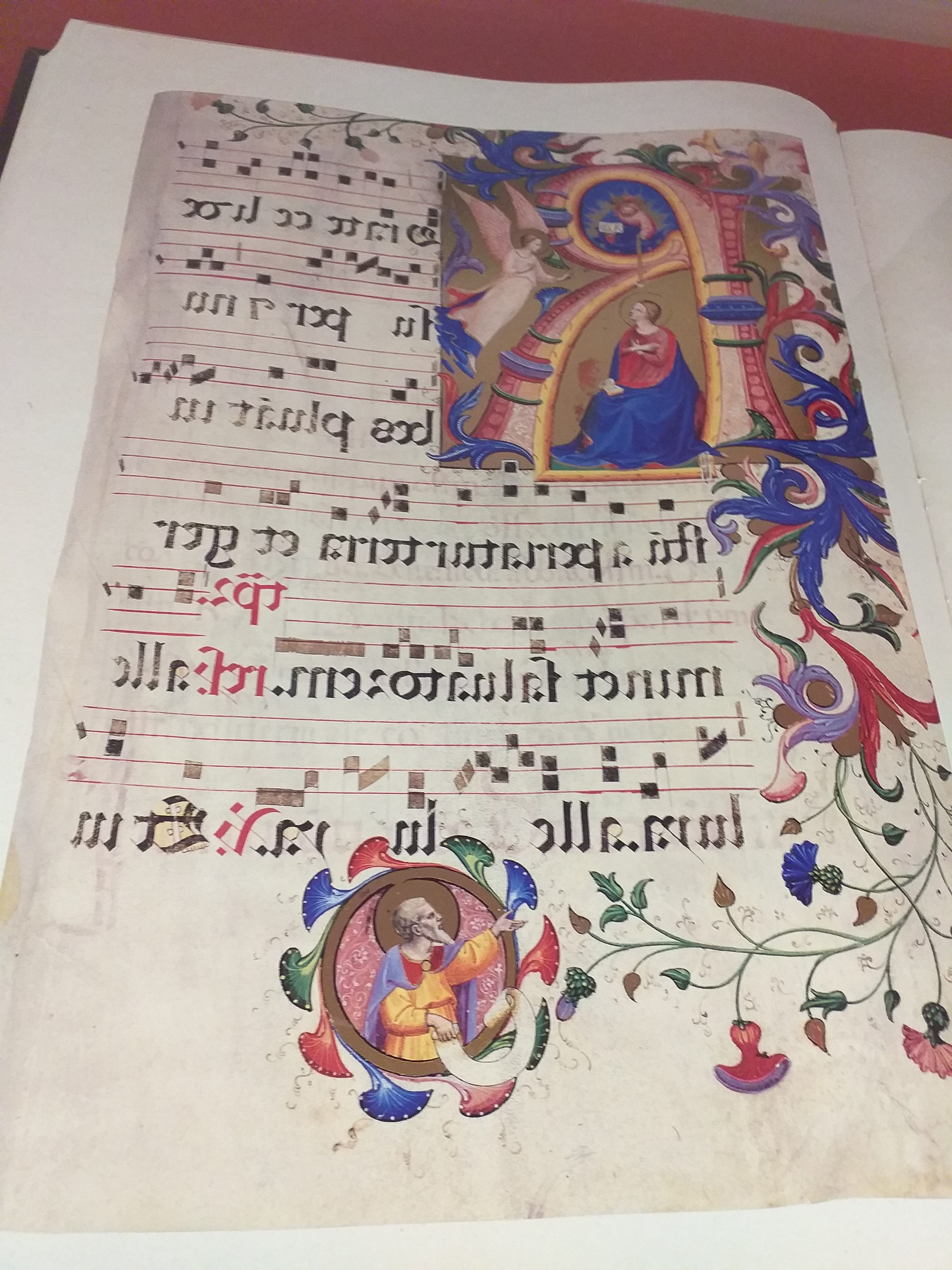
g) Music notation as it used to be scripted