Why Visit Cork
Tuesday, 3rd September 2024
Why visit Cork?
Even though Ireland is a small island and Cork is an even smaller part of it, Cork Harbour is said to be the second largest natural harbour in the world after Sydney Harbour.
County Cork is a spellbinding place home to rugged coastline, wildflower-studded mountains and stones with magical properties. Cork is the largest and southern most county in Ireland. Nestled in the South West of Ireland Cork is the doorway to the Ancient East and the Wild Atlantic Way. Cork offers the history, heritage and landmarks accompanied by artisan food and drink and a strong cultural, musical and artistic vibe.
What enticed me to visit Cork
1 Cork is my mother’s birth place
2 I wanted to meet my friend, Noreen, who recently moved back to Ireland
3 I will reveal my hidden agenda later. It involved visiting islands.
I love Islands. I have visited many: The list is long: Nearly all the Channel Islands: Isle of Wight, Jersey, Guernsey, Alderney, Sark, Herm and then up north; the Holy Island of Lindisfarne.
Of the Italian islands, I have holidayed in both Sicily and Sardinia.
You will know that Venice, the capital of northern Italy’s Veneto region, is built on more than 100 small islands in a lagoon in the Adriatic Sea Therefore, it too is essentially an island. I loved being in Venice and Murano, Burano and I swam off Lido island.
I enjoyed my visits to the Spanish Islands of Tenerife, Fuerteventura, Gran Canaria, Lanzarote. In North America I travelled from the peninsula of Cape Cod to Nantucket and Martha’s Vineyard. I also holidayed twice in Madeira. I can add Malta to my list.
I have often visited the islands off the west coast of Ireland. Any holiday in the west of Ireland surely should include a visit to one of the 7 islands off the West coast that consist of the the three Aran Islands of Inis Mor, Inis Meain and Inis Oirr. Clare Island, also historic Inishcleer. A mountainous island guards the entrance to Clew Bay in County Mayo leads imperceptibly to Achill Island. I enjoyed a grand time there with a group of Irish teachers on an Irish language course. My latest visit was to Heir Island in Skibbereen.
Visiting my homeland satisfied my longing of being on Heir Island located off Skibbereen in West Cork. Little did I foresee, though, how much I was to gain by this wonderful and fulfilling experience.
———————
My mother was born in Montenotte Cork. She might just have heard others saying that this is a prosperous area.You see, my mam lived at a time when it seems that it was important to claim that you were well connected. She wouldn’t have been aware of entries in encyclopaedia and of course our sort of social resources were not available back in the 1940’s and 50’s. Bragging, social engineering and claiming to belong to persons of importance was often resorted to. Therefore the following statement would have suited her when she said that Montenotte was the place of her birth.
Montenotte is an area in the northeast of Cork City, Ireland, which was home to merchants and a prosperous middle class from the early to mid-19th century. It was named after the late 18th century Napoleonic battle. Montenotte is situated on a hill facing south over the River Lee. Originally home to several substantial residences.
This type of showing off or on-upmanship gained people advantage or feelings of superiority over others!
Of course the big attraction for my visit to Cork was meeting my long-time friend. Noreen moved back from England to live a short train ride away in Mallow. We taught together in Battersea, so we had a lot of catching up to look forward to. The opportunity to do so was even greater when Noreen generously offered to accompany me throughout my visit. In fact, Noreen took on the role of travelling companion, tourist guide and much more.
I flew Aer Lingus. I vowed never again to go with Ryan Air after my previous experience of flying to Shannon. When I landed in Cork Airport, Noreen had given me the number of the bus to board to take me into Cork City. She awaited me there. With difficulty we had managed to pre-book a nights accommodation in a Premier Inn in Central Cork.(More of that later). The following morning after a great deal of chatting over breakfast, we boarded the bus to Skibbereen. It’s a two hour bus journey providing a great experience of viewing a wonderful panorama of interesting towns and of course the beautiful gently undulating countryside. Relaxing on our front seats we became imbedded in the Ireland of today. A woman who took advantage of a short stop to run across the road to purchase a sandwich and something to drink. We noticed the young folk removing their earpieces before informing the bus driver of their destination and then tapping their payment cards on the bus fare machine. Folk with varying skin colours skin at home with the natives often speaking with Irish accents. All so peaceful and integrated.
We arrived in Skibbereen midday. We didn’t know where West Cork Hotel was situated. I spotted a woman getting into her car and crossed the road to ask for directions. After eyeing us up and down Mary Fitzgerald said: ‘It’s near but it’s on a one-way system. Would the two of you like to pop in and, sure I’ll drop you off at the place’. Delighted we managed to scramble into a heavily ladened not too clean car.
Noreen and I were warmly welcomed into the well established and much loved, renowned, West Cork Hotel. As far as I remember, the chap at the desk said he came from Croatia and in the restaurant, smiling Mohammad constantly catered for our every need and old time, Sheila, who initially reminded me of Julie Walters playing the elderly waitress in Victoria Wood’s famous ‘Two soups’, sketch, took her time getting to know us. I nearly burst out laughing at breakfast the next morning when Sheila approached Noreen seated at a table for four and asked: ‘Expecting someone else, are we?’ Sheila must have known that there were only two of us because on entering the restaurant she had just checked off our rooms on the breakfast list. While I bit my tongue, my smiling eyes must have unveiled my humour. After that Sheila made sure that we were well catered for at what became our usual table. The local student staff on holiday from universities were friendly, efficient often ready to offer information about the local area. This hotel overlooking the River Ilen provided a very welcoming environment.The hotel chef nourished us with delicious, plentiful dishes and was not perturbed if one of us decided to have a child’s portion.
I could have selected to visit any of the eight islands off Skibbereen but what drew me to choose to Heir Island was the warm welcoming response that I received from Sarah when I emailed her before deciding which of the nearby islands to visit.
Of the eight off West Cork islands, seven are inhabited: Heir Island, Sherkin Island, Cape Clear Island, Whiddy Island, Dursey Island, Long Island and Garnish Island.
How could I resist choosing Heir Island after I received:
Thank you for your email. I have also spoken with your friend Noreen and I believe you may be staying on the island when you visit.
I look forward to hearing from you when you are clearer on your itinerary and welcoming you to the island when the time arises.
Warmest regards,
Sarah
Sarah Matthews
Tel: 087 2856757
Web: https://www.heirislandretreat.ie
Instagram: heirislandretreat
The hotel had a list of taxi drivers to choose from to take us from Skibbereen Cunnamore Pier. The journey takes approximately twenty minutes. Leaving the main roads the driver skilfully weaves through winding boreens to the pier. Once at Cunnamore Pier we waited for a short time. We were delighted when Sarah’s husband, Paul, approached, welcomed us and offered to drive us to their lovely home and retreat centre once we disembarked from our short ferry crossing
Sarah and Paul gave us such a warm welcome. I will continue to to tell you about the wonderful time that we spent with these wonderful people further on, but read the following first:
I have copied and pasted information about Sarah from an article featuring her life on Heir Island in the local Evening Echo:
Heir Island or Hare Island, also called Inishodriscol, is one of the Carbery’s Hundred Isles in Roaringwater Bay in the southwest of County Cork, Ireland.
It has a small population of approximately 30 people. The island is 2.5 km long and 1.5 km wide. It is the fourth largest of the local islands after Sherkin island and Clear island and Long Island. There are no hills except for the slight incline up from the harbour but after that it’s a easy walk around the island. It is a peaceful and special place.
When you disembark, head away from the harbour until you come to a cross roads. Take the left road to go down to the beach or go right to find a lovely little spot where you can treat yourself to a wood-fired pizza at Pizzaheiria. If you go straight on from the crossroads you may walk to the very end of the island. This area is known as Paris. From here you can see Sherkin Island to the left and Cape Clear Island straight ahead. You should be able to also see Fasnet Rock in the distance with it’s lighthouse. To the right, looking out from Heir Island you can see the Mizen peninsula. Its a fabulous panoramic view, a great reward for a very easy hike.
The Babies Cemetery
Along the way you will pass the old schoolhouse and Gort NaCille, a graveyard for unbaptised babies. It is sad to think that, not so long ago, unbaptised children were not allowed to be buried in their family graves but instead were buried at night in a separate place. The inscription on the plaque says ‘A Cillin was a graveyard primarily used to bury unbaptised children. Unlike normal burials, internments in the cillin took place at night. The burial was usually carried out by the child’s father with the aid of a male relative or neighbour.’

Wildlife & Nature
The island is home to a wide range of habitats from farmland, sandy beaches, rocky shore, heath, bog and salt-marsh. The native wild flowers are stunning in the summertime. Hedgerows of orange monbrieta, red fuchsia, white wild rose, purple thistle and red clover mix together in perfect harmony. There is a very healthy population of butterflies which is a joy to witness, long may it last.
Heir Island’s marshlands are home to many species of birds. Several migrant bird species may be spotted including Merlin, Purple & Curlew Sandpipers, Hen Harrier, Pintail, Black-necked Grebe and American Golden Plover.
Heir Island is the perfect spot for hiking, birdwatching and watching nature do its thing!
——————————
Now more about Sarah and Paul:
Noreen, Sarah and I. Window of house from gives a great panoramic view and Green water pump.
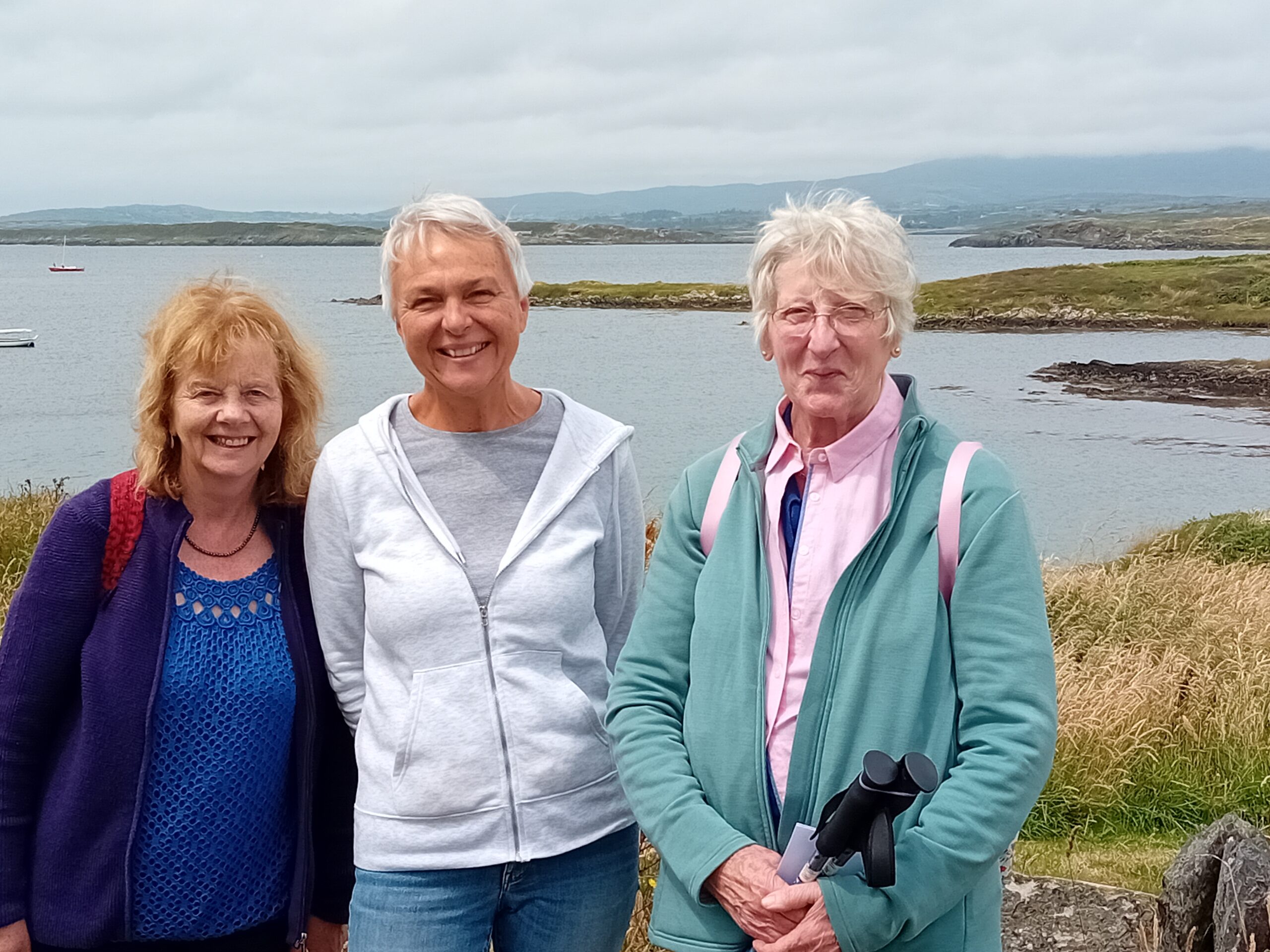

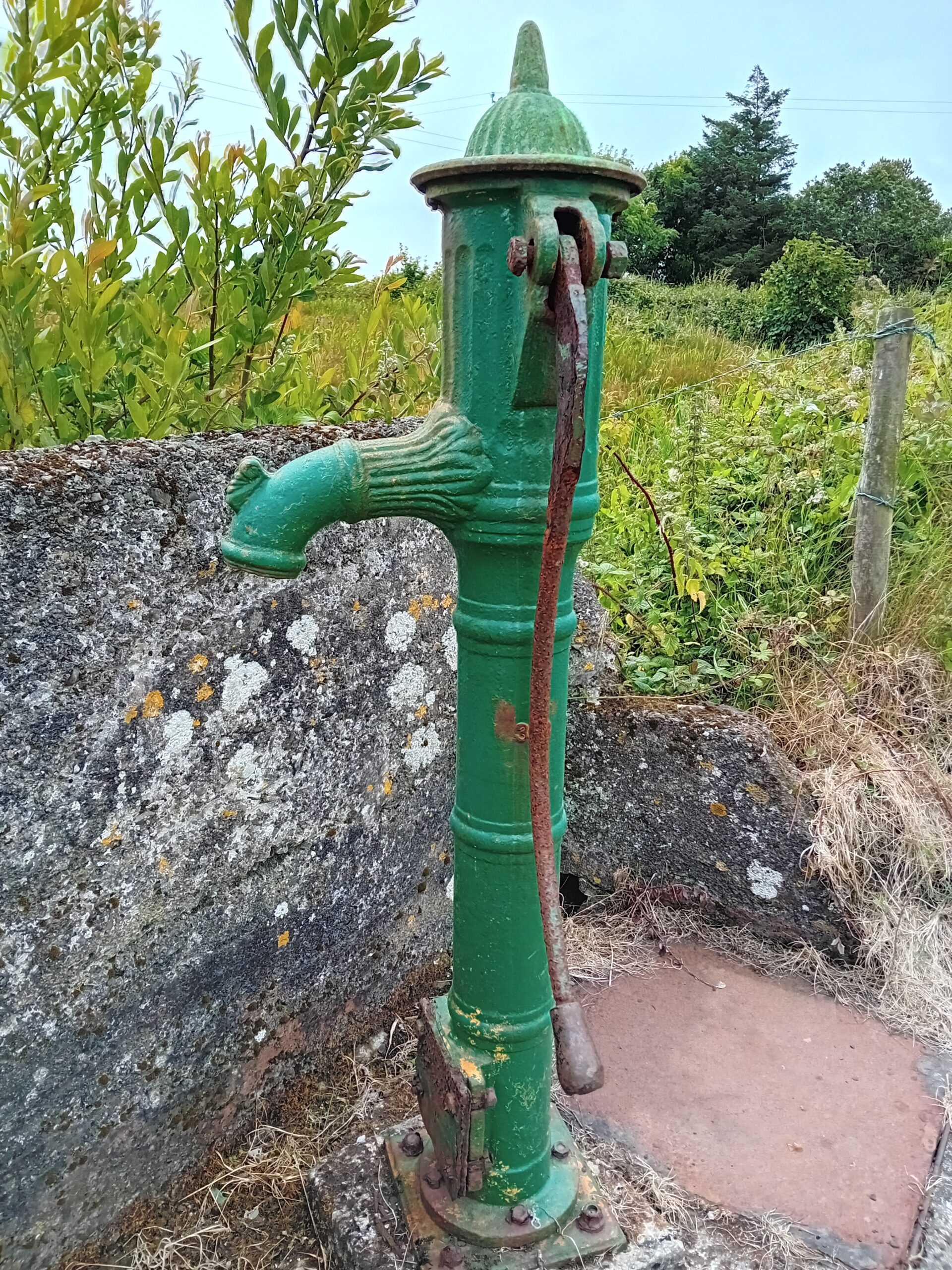
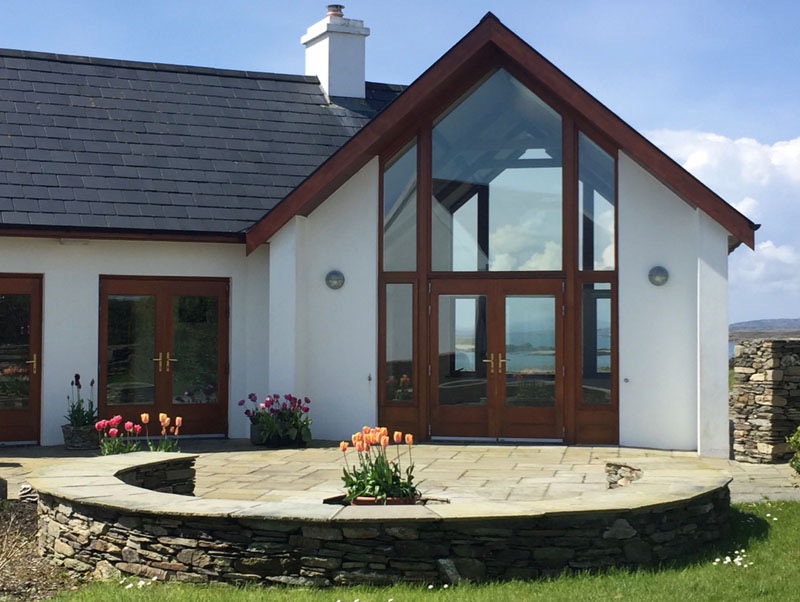
As I said above, Paul took care of Noreen and I as we arrived from Skibbereen and waiting on Cunnamore Pier until the small ferry boat docked.
This ferry only seats fourteen persons. Some of those boarding were musicians hailing from various countries. They were carefully carrying their various instruments: a harp, violin….etc. They were booked to play at a classical concert that evening. When I asked them to name one of the music pieces that they intended to play, a lady said the 13th-century Stabat Mater was on their programmes.
As soon as the boat started, I immediately sensed the sheer pleasure of being at sea. There’s nothing quite like it! Mesmerised yet fully conscious, breathing in and filling my lungs with fresh sea air while almost touching the clear water, I was rejuvenated.
True to his promise after the ten minute crossing, Paul drove Noreen and I in one of the few vehicles permitted to be driven on Heir Island. En route this friendly man related his and Sarah’s history on the island while we journeyed along the narrow road to their property. What a property! What a welcome! Sarah and Paul warmly embraced us and offered refreshments. Their ten year old relative, Noah, hugged us and then continued consulting an oven thermometer ready to take the biscuits that he was cooking out of the oven as soon as they were cooked.
We were very fortunate in befriending these hospitable people. There was so much to imbibe in their beautiful home and artistic and yoga centre. They had tastefully built, adapted, gardened and enhanced all around them. We gleaned so much information while they shared their stories and were nourished with so much. I have added the link to the Evening Echo article featuring Sarah:
https://www.echolive.ie/wow/arid-41418841.html
I also found the following information about the boat company in which we travelled:
https://eoceanic.com › sailing › harbours
Heir Island is accessible by boat all year round by ferry. The main way to get to the island is via the island ferry that departs from Cunnamore …
The weather was favourable for walking throughout this lovely rugged Island. We loved it all. The fauna and flora, the cows, the beaches, the fresh sea air and spectacular views. Meandering up and down pebbled paths we only met three other people. We could have stayed there much longer but we were aware that musicians and their audiences would probably need to use the ferry as the time for their concert approached. We also needed to return to Skibbereen. Reluctantly we boarded the ferry back to the mainland cherishing happy memories and determined to spread the news to as many people as we can. We both vowed to returned to Heir and are determined to encourage others to enjoy visiting Heir Island.
_________________________________________________________
We fell in love with Skibbereen.
Skibbereen in West Cork is the most southerly town in Ireland. According to Wikipedia it had a population 2,903. Situated on the Ilen river, this town has a troubled past. It was founded by English settlers after nearby Baltimore was sacked by Algerian Pirates in 1631. Hundreds of people were taken as ‘white slaves’. A small number of survivors rowed up the river Ilen to establish the town where it is today.
The Great Famine – an Gorta Mór
In the 19th century the town was one of the hardest hit by the Irish potato famine. The mass graves from that era can still be seen at the local cemetery. Locals sing a song, called Dear Old Skibbereen that recounts those famine times.
Before the Famine, Skibbereen had developed into a thriving market town, trading in linen, wool and agricultural products. However, it was devastated by the Great Famine of the 1840s. One million people died and at least another million and a half emigrated during this appalling period of Irish history. As one of the worst-affected areas in all of Ireland, Skibbereen is synonymous with this tragic time.
A settlement just east of the town, based around the castle of the overlords, were the MacCarthys. This wealthy Gaelic family forfeited its estates during the turbulent 17th century. *English Planters, William Prigg and Samuel Hall were given Market Rights by a 1675 Patent. There was also a Cistercian Abbey on the banks of the Ilen from the 13th century.
(*English Planters: The late medieval/early modern period marked a fundamental turning point in Anglo-Irish relations. Prior to this, English control of Ireland had remained a largely nominal affair, however the Tudors become increasingly concerned about the threat that Ireland posed to English security. Following a rebellion in 1534 Henry VIII declaring himself King of Ireland signalling the beginning of a much more aggressive English colonial posture. The plantation of Ireland must be understood not only in the context of the potential threat which successive monarchs regarded Ireland to be, but also in the light of the theological revolution which was to redefine Europe’s religious landscape and radicalise relationships between the two islands. The fact that Ireland remained Catholic while Britain turned towards varying degrees of Protestantism introduced a new and complex dimension into Anglo-Irish relations which would provide the basis for mutual distrust and suspicion.)
The circular enclosure to the north of the graveyard, was the location of the early monastic site:
It is likely that the graveyard was initially used as a burial ground for the nearby monastic site and gradually came into use by the general population. There is a small section of the graveyard, on the right when you enter via the main gate, which was used by the local Protestant community, while the remainder of the graveyard was used by the local Catholic population.
Many of the buildings in the town have direct links to the Famine and there are numerous stories associated with each of these sites. Even today, the horror of this terrible time is palpable at these locations.
The infamous Famine Burial Pits at Abbeystrowry holds the remains of up to 10,000 unidentified victims. Abbeystrowry graveyard is on the site of a medieval Cistercian monastery.
Maid of Erin 
A statue, the ‘Maid of Erin’ erected in 1904, sits on top of a memorial to commemorate four failed uprisings against British rule, the dates of which are engraved on each side of the plinth: 1798, 1803, 1848, 1867
Skibbereen is also said to be the ‘Cradle of Fenianism’.
The famous Irish revolutionary Jeremiah O’Donovan Rossa became politically active in Skibbereen just after the Famine. He went on to become one of the leading members of the Fenian movement.
O’Donovan Rossa is commemorated in Skibbereen at O’Donovan Rossa Park, just outside the town. The local GAA club is also named in his honour.
A well-known Irish revolutionary, Gearóid O’Sullivan, from this area, took part in the Easter 1916 Rising. He raised the Irish flag over the GPO during that infamous rebellion.
O’Sullivan was a good friend of Michael Collins, another renowned West Cork revolutionary. Collins stopped at the Eldon Hotel in Skibbereen on August 22nd 1922. Later that day, he was shot dead at Béal na Bláth. (Dublin)
The decades after the Famine saw major improvements in the town. The building that now houses Skibbereen Heritage Centre opened as a Gasworks in 1867 and the arrival of the railway a few years later heralded a new era for Skibbereen.
Science was also to the fore in 19th century Skibbereen. The celebrated astronomer, Agnes Mary Clerke, was born in Skibbereen in 1842. The ‘Clerke Crater’ on the moon is named in her honour. Another Skibbereen native, Percy Ludgate, designed the ‘analytical engine’, which is regarded as the first portable computer.

We were delighted to speak to Cathal O’Donavan the owner of Skibbereen Book shop with his slogan A Book for Every Reader. He adds that If you can’t find that special book you are looking for you only need to ask a member of staff and they will gladly source the book for you from our Irish or English suppliers within 4-10 days.” He claims that their bookshop offers reading material from contemporary Irish and international fiction and poetry, non fiction…..
He recounts that : Five years ago we had the pleasure of meeting a man in our bookshop of ninety six years of age who was physically and mentally as agile as any sixty year old. He was born in 1920.He remembered sitting on his grandfather’s lap and being told about Famine stories- his grandfather had lived through and survived the Famine. Such is the closeness of modern Irish history in the mind and in time. Much has been written about Ireland during the 150 years post Famine. With all its attendant political, and sometimes violent history, its intrigue, its leaders, rebellion, independence in 1921, constitution in 1937, republic in 1949 and revisionism of recent years it has evolved into a modern democracy.
Noreen and I took pleasure chatting with Cathal O’Donavan. A good humoured approachable and knowledgable gentleman willing to share his wisdom and experience. On our last day in Skibbereen he hooted and wave to us as he drove past the stop where we were waiting for our bus back to Cork City.
__________________________________________________
Cobh Island A tourist attraction, indeed!?
When we arrived back in Cork city, Noreen returned to her home in Mallow
and I planned my final day in Cork. A visit to Cobh was a must.
The following morning I took the train there.
Google Cobh and you will find that it is described as a tourist attraction! Not so.
Cobh is the place from which there was enforced mass exodus from Ireland during the 19th Century. It was known as “the saddest place in all of Ireland.’ It was the embarkation port of some three million Irish emigrants fleeing famine and poverty between the 1848 and 1950. It was even known as Queenstown. In the 1600’s transportation to the British overseas colonies was commonplace, from Virginia and New England to Barbados, Jamaica and Monserrat. it is the time when transportation of convicts to Australia. The connection between this port town and two of the biggest shipping disasters of the early 20th century were the Titanic and the Lusitania.
I read ‘Star of the Sea’ in preparation for what I was about to see.
I am inserting a summary that can be further explored on Wikipedia:
Star of the Sea is a historical novel by the Irish writer Joseph O’Connor published in 2002. The novel is set in 1847 against the backdrop of the Irish famine. Star of the Sea became an international number one bestseller, selling more than 800,000 copies in a year.
The Star of the Sea of the title is a famine ship, making the journey from Ireland to New York. Aboard are hundreds of refugees, many from humble and desperate backgrounds. Key protagonists are David Merridith Lord Kingscourt, his wife Laura, their servant Mary Duane, the ship’s captain Josias Lockwood, a friendless Irishman named Pius Mulvey, and American journalist Grantley Dixon.
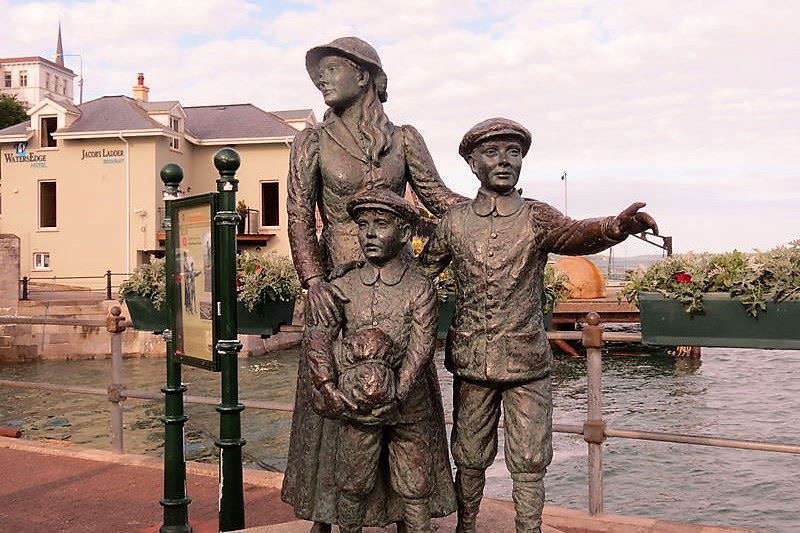
The Irish famine only began coming to an end in 1849, when British Troops stopped removing the food from Ireland. While enough food to sustain 18 million people was being removed from Ireland, its population was reduced by more than 2.5 million, to 6.5 million.
______________________
Tear-filled and exhausted after visiting the sanitised Cobh expedition, I wondered if I should journey to Spike Island. Fresh air beckoned me and a distance memory nagged me, too.
Again another sea crossing to yet another island was wonderful. A bigger tour boat and slightly longer crossing on a beautiful sunny afternoon enticed me. Inevitably I made friends with a couple from England en route. Those who know me will not be surprised at the latter.
A young guide welcomed us. It was when he began to speak about the history on Spike Island that I remembered that my great uncle Michael Colivet was a political prisoner on this Island.
This great uncle was Colivet, Michael Patrick (1884–1955), revolutionary and civil servant, was born 29 May 1884 at 11 Windmill St., Limerick, son of John Colivet, able seaman of Jersey, Channel Islands, and Ann Colivet (née Kenrick) of Askeaton, Co. Limerick.
Essentially my great uncle was imprisoned because he was a republican.
I found this quotation: Michael Colivet was re-elected unopposed at the 1921 elections for the Limerick City–Limerick East constituency. He opposed the Anglo-Irish Treaty and voted against it, stating in the Dáil debate:
“I am now asked to throw out the Republican Government and accept the status of a Dominion within the British Empire. Many men can find it within themselves to reconcile such with their previous views and opinions whether they were expressed in oaths or in any other form whatsoever. That is their business. I am only concerned with mine, and my point of view is, I cannot do that thing. I have declared myself a Republican, and have been elected a Republican, and I will never willingly become a subject of the British Empire”.
Conditions on Spike Island? I have copied the following:Prisoners were heavily chained and clothed in black from head to toe with a veil hiding all but their eyes. Conditions inside the block were the harshest inside the prison. At first, the cells were furnished with only a stool and convicts slept on the floor.
Why was Spike Island so important?
Spike Island

Spike Island first became an island prison during the mid 1600s, when thousands of prisoners were kept here during the Cromwellian conquest of Ireland. This identity stuck, and the island would again become a prison during the Great Famine in 1847. In fact, at this time it was the largest known prison in the world!
Men and boys were incarcerated, laboured and died in the prison on Spike Island. The integrated study of skeletal remains and material culture will give a voice to those silenced in the past and tell of the lived experience of penal servitude. This project has relevance beyond Ireland and the Irish diaspora: the 19th century was a critical period for the development of the modern prison system with considerable innovation and experimentation in methods of incarceration. Spike Island was one of the locations where such experimentation was carried out. It was one of the hubs of a penal system that had a global reach.
Eventually, under the Anglo-Irish Agreement of 1938, the transfer of the ‘Treaty Ports’ was finally approved.
The handover of Spike Island to the Irish Government took place on 11 July 1938, on the 17th anniversary of the 1921 Truce. The ceremony was attended by then Taoiseach Éamon de Valera and was watched across the harbour in Cobh by an estimated 40,000 people who cheered the raising of the Tricolour over Cork harbour forts for the first ever time. In the mid-nineteenth millions of people to the brink of starvation. This catastrophe, combined with the simmering social, religious, and political tensions associated with British rule in Ireland, forced thousands of people to flee the country each month. Many of them left from the small town of Cobh, in Cork Harbor. During the nineteenth and early twentieth centuries, as many as 2.5 million Irish men, women, and children departed from Cobh alone, more than from any other port in Ireland. Tearful families gathered on the waterfront to say their goodbyes. Many were seeing their loved ones and their homeland for the last time.
A monastery was built on Spike Island in 635 AD after its founder Saint Mochuda (also known as Saint Carthage) cured the High King of Ireland and was granted ‘land including Inis Pic forever more’. He set up the monastic outpost and spent one year on the island before departing. He left 40 followers behind to carry on his work and he founded another famous monastery in Lismore, County Waterford. The disciples left behind on Spike Island carried on his work with distinction, with later descriptions stating “that island is a most holy place in which an exceedingly devout community constantly dwell”.
The island was a safe haven with ample safety and sustenance for the monks, who farmed the land and fished the waters. That was until the Vikings came storming into Cork harbour in 820 AD, and at the very least this likely meant a temporary abandonment of the site. There are reports of a monastic community in operation as late as the 16th century, suggesting varying degrees of occupancy across an amazing 900 years.
My great uncle, Michael Colivet, was imprisoned in many places because of his convictions:Colivet was a member of the IRB, joined the Irish Volunteers in 1914, and was commandant of the Limerick command during the 1916 rising. Imprisoned in Frongoch, he was released in December but rearrested in February 1917 and interned at Fairford, Oxfordshire, from where he escaped in June. Apprehended in October 1917, he was sentenced to six months hard labour for ‘seditious speaking’ and subsequently incarcerated in Lincoln prison. Elected in December 1918 as Sinn Féin MP for Limerick city he was again imprisoned, this time without charge, and kept in solitary confinement in Rathkeale prison, where he suffered from a skin disease and was refused parole to see his dying wife. Elected as Sinn Féin TD for Limerick city and East Limerick (1921–3) and as an alderman on Limerick corporation (1921–6), he was to the fore of the Belfast boycott (1921). He opposed the treaty and was one of twelve members of the second dáil to be nominated by Éamon de Valera to the anti-treaty council of state; after the arrest of Austin Stack on 14 April 1923 he acted as minister for finance in the republican government. He was one of five members of the republican cabinet who decided at a meeting with the IRA army council (26 April 1923) on a halt to hostilities. In the ensuing general election (27 August 1923) he stood unsuccessfully for Limerick.

Frongoch
Frongoch prisoners of war from the Easter Rising of Ireland
Originally the camp housed German prisoners of in a yellow distillery and crude huts, but in the wake of the 1916 Easter RisingEaster Rising in Dublin, the German prisoners were moved and it was used as an internment camp for approximately 1,800 Irish republicans, among them such notables as Michael Collins, who were accorded the status of prisoners.
It is a rectangular timber-studded hut with horizontal weatherboarding and a felt roof with plain bargeboards. It is raised up on brick piers. The main (road-facing ) side has a central entrance with paired openings whilst that to the right is now boarded-up. It also has a four-panel door which is flanked by two four-pane windows on each side, with tilting upper sections. There are two further windows to the NW gable end and one window each to the SE gable and rear elevation.
_______________________
I interrupted the young guide who was giving a version of the history of Spike Island to let those in our group know that my great uncle had been imprisoned there.
With this personal connection I seemed to become a person of notoriety.
I left the group as soon as the guide left us to follow a trail and discover more for ourselves and began searching for further information about Michael Colivet.
Another young chap in the shop became very enthusiastic about my family connection and was keen to provide me with relevant information. He took me to the book shop where I bought a copy of both books pictured below. the young lady who served me told me that the book on the left was published by her father. It was a first editions of

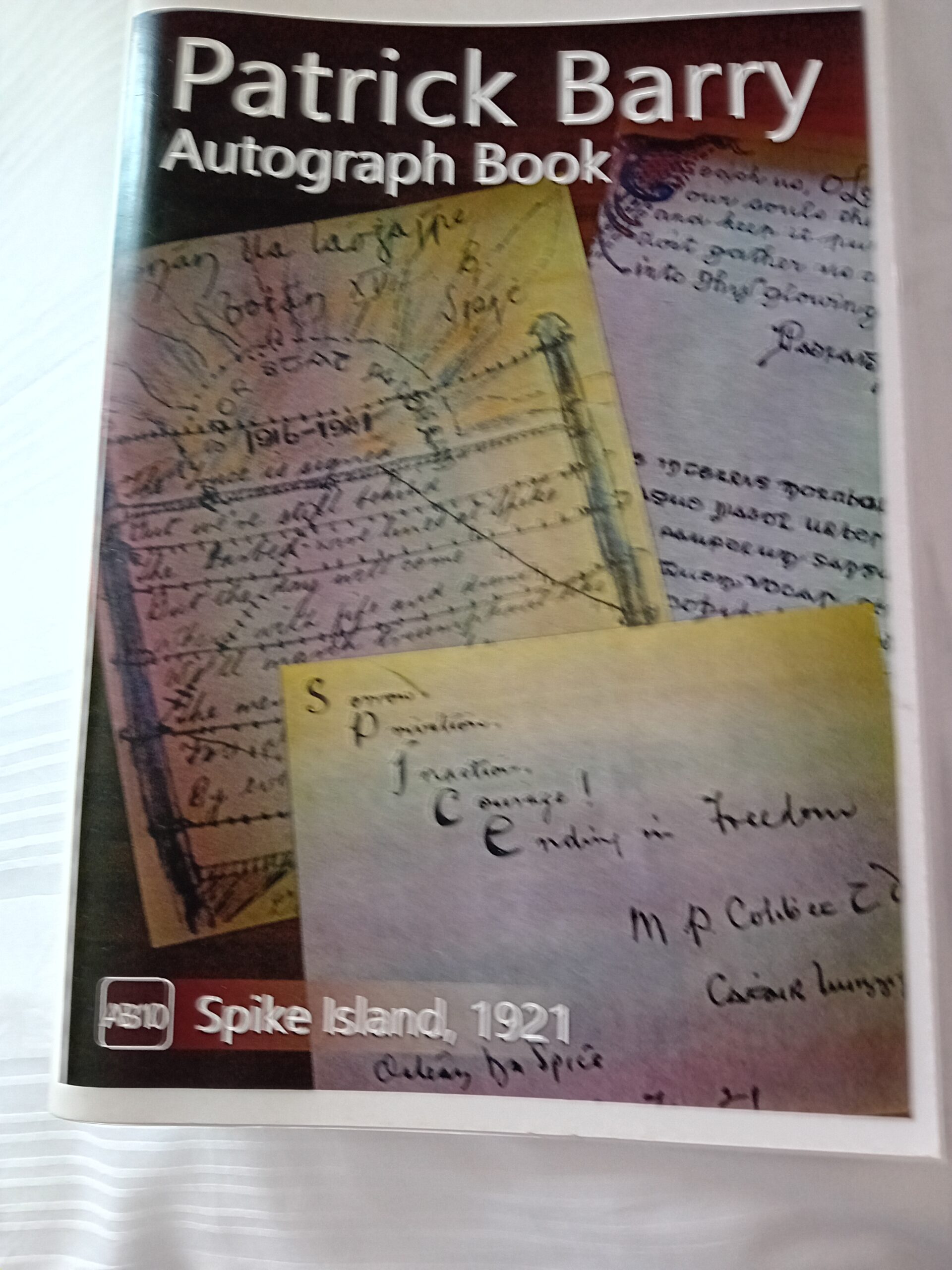
Of the second book it is stated:
—————————————————————————-
Walking back to the boat that would take me back to Cobh the young man who had provided me with the information about my great uncle became even more enthusiastic when I told him that I have been told that I am also related to the great Irish poet
Máirtín Ó Direáin. He told me that he had studied his work at university and earlier on at school. He is on the curriculum.
The Lamp lighter
There is a plaque bearing the words of the poem ‘Fear Lasta Lampaí’ or ‘The Lamplighter’ in English, by the Galway poet Máirtín Ó Direáin.
Máirtín Ó Direáin (29 November 1910 – 19 March 1988) was an Irish poet who is widely held to be one of the foremost Irish language poets of the twentieth century. A native of the Aran Islands Gaeltacht, Ó Direáin later spent time working in Galway and Dublin, where he upheld a connection to Gaelic affairs through Conradh na Gaeilge and Taibhdhearc na Gaillimhe. A significant theme of his poetic works deals with the tensions between the urban and rural, modernity and tradition, the English-speaking world and Gaeldom.
While Ó Direáin was rooted deeply in the Gaelic tradition, his poetry also shows influence from wider European writers. His influences included Nietzsche, Spengler, Yeats, Haicéad, Ó Bruadair, Bedell and Shakespeare.
Fear Lasta Lampaí is a short and simple poem by the Aran Island poet, Máirtín Ó Direáin. The poem captures a simple scene in just a few short lines: a man going about his work lighting the street gas lamps in Galway city in 1928. But don’t be fooled. Just as his fellow islander, Liam Ó Flaithearta, did in his poem Na Blátha Craige, this carefully crafted poem uses a simple scene to convey so much more than at first glance.
From the Aran islands to international fame
Máirtín Ó Direáin was born on Inis Mór, the largest of the Aran Islands, in 1910. He was a monoglot Irish speaker and only learned English in his mid teens. He would not have left the island much, if at all, before moving to Galway city at the age of eighteen to take up a job as a clerk in the main Post Office. (If you are ever in Galway have a look at the plaque in his memory on the external wall of the post office building on Eglinton street).
Ó Direáin’s first poetry collection, Coinnle Geala, (Bright Candles), was published in 1942. His poetry turned away from the traditional form and revolutionised Irish language poetry in the 1940s and 50s. W.B. Yeats was not the only Irish poet to enjoy international fame: Ó Direáin also received international acclaim during his lifetime and was the recipient of many prestigious awards including the Ossian Prize for Poetry.
Coláiste Ó Direáin
Coláiste Ó Direáin is an Irish Summer College in County Galway that was founded in 1984 to teach the Irish language courses to the youth of Ireland in an enjoyable and active way. This Irish language college in Galway provides expertly run two week courses during the summer on beautiful Inis Mór, Aran, Co Galway. Mairtin

Fear Lasta Lampaí. le Máirtín Ó Direáin.
Ní raibh sé mór an fear
Níor dheas a bhí ach gránna,
Is cóip an bhaile mhóir
Ag fonóid faoi gan náire,
Ach ghluais gan mhairg fós
Is ar chuaillí chuaigh in airde
Ba dhraíodóir an fear beag
A raibh an solas ina ghlaic,
É ag tabhairt na gile
Ó lampa go lampa sráide
The Gaeltacht college named in honour of Mairtin O /direain is based in Fearann an Choirce, in the centre of the island and student houses are located in many villages on the island.
Why did I want to travel to Cork, Skibbereen, Heir Island, Cobh and Spike Ireland?
I am planning to write my fourth novel featuring being on an island.
_______________________________________________________
Now for an account of our struggle to contact Premier Inn in order to make a booking:
| Cork City Centre
14 Morrison’s Quay, IE, T12 C862 Telephone: +353 300 3730 329 |
| Cork City Centre
Check in Check out This is a Standard rate booking, which can be amended up to 1pm on the day of arrival on a like for like basis. The fastest way to manage your booking is online on our website, just click here and enter your booking details. Please see our website for full cancellation terms and conditions. |
| Booking confirmed
Booking Reference BLR6676908 |
thus 18th and 19th
Monday Premier Inn 15th
Thur Premier 18th
Fri Premier Inn 19th
My friend Noreen and I opted to book one night’s accommodation in Cork City Centre .Details above.
We travelled to Skibbereen to stay in the West Cork hotel for the following two nights, 16th & 17th
On the 18th Noreen returned home. I was booked in the same Cork City Premier Inn hotel for a further two nights 18th and 19th.
We experienced great difficulty booking our first stay on 15th July. Noreen, who lives nearby Cork City Centre Premier Inn in Ireland, tried several times to book online for both of us. Failing that she tried phoning Premier Inn.
Here in England, I too endeavoured to book for both of us on-line and by phoning. Eventually late one afternoon. I managed to make contact with a very helpful Premier Inn member of staff, located in Premier headquarters Derbyshire. Finally both Noreen and I were relieved.
On arriving in Cork City Premier Inn on Monday 15th July we booked in and then went to our rooms. As we intended to board the bus to Skibbereen the following morning we decided to eat in the Premier Inn restaurant that night.
I slept soundly but Noreen eventually was forced to move from the room that she was assigned.
Feeling cold Noreen attempted to increase the temperature in her room. Conscience that I was tired from travelling, she decided not to contact me. She followed the Premier Inn instructions provided:
How do I use the heating and air con:
Your room is air conditioned and the windows are sealed to ensure the most effective heating and cooling times. You can control the heating and air con using the touchscreen control panel in your headboard.
Little did she realise that the Premier Inn appears to use something similar to a General Electric Co.that centrally controls the heating and air conditioning units for hotels and motels. These systems disable controls preventing residents from adjusting wall thermostats, that guests are instructed to use in order control a heating and cooling unit.
Frustrated and cold with her attempts to try and heat her room that that was now colder and had resulted in dampness invading all around her, Noreen phoned the staff. After several attempts eventually after midnight a member of staff after failing to adjust the thermostat `greed to move Noreen to another room on a higher floor.
The following morning having slept well, and before I realised what had happened to Noreen, I decided to book two nights in the hotel for 17th &18th when I returned from Skibbereen. I met the manager of the Cork City Centre Premier Inn and asked if I could do so. And to my surprise he said that although I was standing beside him in said hotel, I would have to book on-line! Exasperated at this ridiculous requirement I replied that I found booking on-line difficult. Eventually he opted to use my phone and book for me. By his side, I supplied my details for him to fill in on my phone. He made two attempts to do so and failed. Third time lucky!
Manager Yan at the Cork Premier Inn, is a patient and kind man willing to help where he can but he had to admit that it was difficult to book a night’s accommodation there.
After spending two peaceful, comfortable and happily eventful days in at the West Cork Hotel in Skibbereen on returning to the Premier inn I discovered that I had been assigned a comfortable room overlooking the River Lee.
Noreen returned home while I visited Cobh, Spike island and then searched to find a birthday gift for Noreen and also to thank her for her friendship plus supporting and guiding me throughout my visit to Cork. I walked the streets determined to find a present that she would really like. I selected a Birthday card with a copy of a Monet painting to match the illustrations on her newly acquired handbag. I sought out a Body Shop outlet where I was able to buy the hair product that I knew she used. Then I purchased a box of Butlers Irish chocolate. As I had not needed to use the 20euros Leap Card that she had kindly given me, I put that together with these gifts inside a yellow paper bag ready to give her on the morning of the 19th July when she arranged to meet me for coffee before I boarded the bus to Cork airport.
I was surprised when I received a WhatsApp that morning from Noreen informing me that she felt very unwell and suspecting to have contracted COVID she was very sorry that she would be unable to meet me.
Upset on both counts I still wanted Noreen to receive her present.
I wondered if I could leave it in a safe place in the Premier Inn until she was well enough to collect it. I therefore inserted the yellow paper bag inside a bigger white bag and wrote Noreen’s name on the outside. Fortunately Manager Yan was on duty that morning. He agreed to place the presents in a safe place assuring me that they would remain there until Noreen was well enough to collect them. I was delighted and grateful when I left the hotel.
Unfortunately, ten days later when Noreen recovered from COVID and journeyed to Cork City Centre Premier Inn, the present that I had purchased for Noreen could not be found. Although various managers endeavoured to find the gift, they failed. Noreen returned at least three other times and on each occasion she was disappointed that said present had disappeared. Noreen told me that on the last visit the embarrassed staff offered her and her husband coffee and some sort of crisps.
On hearing this I tried to phone Premier Inn staff here in England. After several attempts I was able to report this issue to a young? member of staff who told me that he could not help but gave me the number 0333 003 002 which he assured me would be more direct to senior staff who might be able to speak to me. Although I have rung that number several times I have not be successful in making any contact.
So much for Premier Inn accommodation!